
A (failed, perhaps) psychogeographic experiment
Note: this essay was originally written in July of 2023. The author has not been to Barking Riverside since the experiment, so please consider this essay a portrait in time rather than a definitive and unchanging assessment of this East London neighbourhood.
Why am I here? I wondered.
I knew why, of course, but phrasing the question this way allowed me to avoid acknowledging the regret that was starting to creep in. The whole point of today was that there was no reason for being anywhere. It was my first intentionally psychogeographic experiment with London, which has been my home for the last thirteen years. I had devoted an entire Sunday to the synchronistic exploring of a neighbourhood chosen for me at random by an app called Spin the Wheel. A fastidious (and, presumably, bored) individual had input the name of every single tube station in the London area so that all I had to do was tap the wheel on my phone, and instantly it presented me with the name Becontree, a place I had never heard of. I plunged into the day with gleeful abandon, and then several hours later, getting my bearings next to a blue sign that read “Barking Riverside: a place to be, become and belong” while the electrical substation across the road buzzed ominously, I found myself feeling abandoned. By whom? By the agents of chance and luck, who had seen fit to lead me an hour and a half away from my home in South Ealing, teasing and beckoning me down inhospitable roads and littered motorways, until I reached a place that, despite its good intentions and cheerful signs pointing out the wonderful life in store for anyone who has the courage to move there, turned out to be not quite a destination at all.
*
I had recently been introduced to the concept of psychogeography, that is, the exploration of an urban environment by a lone walker, often with an eye to examining the relationship between themselves and their surroundings which unfolds over the course of their walk. Merlin Coverley, in his 2006 book Psychogeography, explains that “in broad terms, psychogeography is… a means of exploring the behavioural impact of urban place”. A psychogeographer is different from a typical tourist (and, in fact, they’re more often a local resident who wishes to deepen their relationship with the city in which they live) in that they begin their ambulatory journey with little to no plan. Sometimes there is an offbeat instruction or prompt (e.g. to pay particular attention to graffiti and street art, to be led by the number three), but mostly the aim is to be open and observe what is presenting itself to you as you move through the city. It is a walk guided not by maps but by feeling.
The more I learned about psychogeography, the more familiar it seemed to me. So that’s what I’d been doing all these years! I pride myself on being the sort of person who can find value, novelty, and enjoyment in any place, no matter how (by popular assessment) ‘dull’ it is. I love to take solo holidays, and my destination is usually not consciously chosen, but rather something that ‘finds’ me (usually because it’s cheap on Booking.com). I have had so many experiences I can only describe as synchronistic or magical while wandering aimlessly in places most tourists would never consider (Southampton, Alfreton, and Bratislava, to name a few). In fact, I’m usually disappointed by the more popular destinations because they are so thoroughly explored and exploited that there’s often no magic, nothing of surprise or wonder, for me to discover for myself.
One of my favourite solo holiday memories is from a trip to Poznan, Poland, where I stumbled upon a free music and arts festival, got sucked into a flash mob dance routine, and ended up being ecstatically dowsed in rainbow pigments like it was Holi. Another, more recently, is from a trip I took to Falmouth in Cornwall, where I spent my days wandering in and out of coffee shops, pubs, and second-hand bookstores, feeling so overcome by inspiration and the cool sea air that I drafted a complete short story by hand (in fact, I posted about this experience online, and a Cornish resident happened to see the post, commenting with almost palpable disgust, “Why of all places in cornwall did you pick falmouth theres a lot nicer places here” [sic]. I replied, “I’ll go literally anywhere, I’d probably have fun in a junkyard, haha – but Falmouth was amazing!! You’re not a fan?” to which they responded with a list of ‘better’ Cornish destinations).
I’ve found it such a challenge to explain to others (such as this unsolicited Cornwall expert) what I love so much about wandering down anonymous streets in regular old cities (and another memory comes to me, which is of a Christmas spent in Aberdeen with my partner, whom I have converted to a love, or at least a tolerance, of unplanned rambling, and how whenever we told friends and colleagues where we were spending the winter holidays, they would invariably ask, “Why Aberdeen?” in a puzzlement that only deepened at our answer, “Because we’ve never been there”; as if holiday destinations need not only a reason, but a good one). Psychogeography gave me a term for what I had so far been doing only intuitively, as well as proof that I wasn’t the only one doing it.
It had been a fair few years, though, since I’d wandered the streets of London in this way. When I first moved to the city from Ohio in 2010, I did this a lot, first thoroughly exploring my then-neighbourhood of Whitechapel, and then branching out into Bethnal Green, Brick Lane, Spitalfields, and the edges of the City near Tower Bridge. Walking London in this way helped me cope with my international move and assist my transition from tourist to resident. Exploring overlooked streets, instead of crowding around buskers in Leicester Square or ducking and dodging other pedestrians on Millennium Bridge, was a way of claiming London as my own – not to mention much-needed exercise for a young university student who couldn’t afford a gym membership, as well as something to fill the time for an immigrant without any social connections. But as my stay in London became prolonged by first a post-study work visa, and then a committed relationship to a British man (still my partner today), the city became more normal and mundane, not something I would gleefully, aimlessly devote uncertain hours to explore.
So with the idea of psychogeography fresh in my mind, I felt myself invigorated by the thought that perhaps, these thirteen years into my residency, it could improve my connection to this metropolis (which has always been contentious, for the sheer reason that I’ve never been a ‘big city girl’). It might also provide me with a cheaper holiday option than packing off to Cornwall every time I get the itch to wander (which these days, to my bank account’s despair, seems to come along at least once a month). I decided, rather grandly, that I would devote one full day every other week to psychogeography. My only rule was that I would go anywhere the Spin the Wheel app chose for me and simply wander around, keeping my eyes open for meaning and magic, and being led by intuition and discovery.
It honestly never occurred to me that this experience ran the risk of being a disappointing one.
*
On my first appointed day of psychogeography, when the app gave me ‘Becontree’ instead of, I don’t know, Pimlico or Kentish Town or even North Dulwich, my initial reaction was disappointment. Becontree was clear on the opposite side of London, a massive hour and a half journey from South Ealing (and the fact that one can travel for so long a period of time and still be in the same city is an interesting psychogeographic point in itself to consider). But I mustered up my spirit of adventure, always held closely in reserve, and told myself it was lucky the app had chosen a station I’d never heard of because I was at least bound to see something new.
I boarded an Elizabeth Line train at Ealing Broadway, changed to the District Line at Whitechapel, and then disembarked at Becontree Station. At worst, I expected to encounter outside the station a greasy fried chicken shop and an off-license, but it was even more dispiriting than that: the station exit led only to a busy street and, across that, a brick wall.
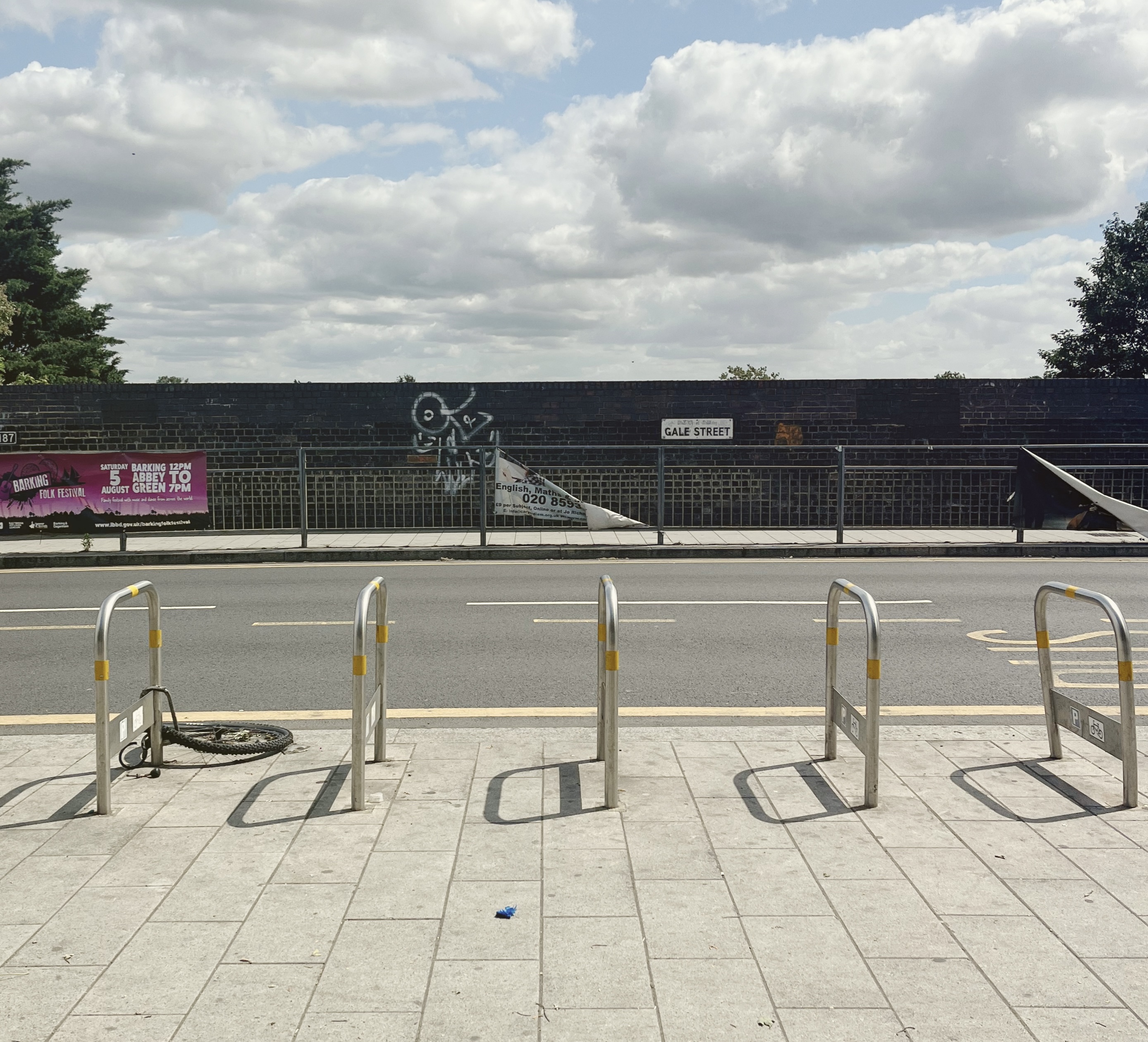
Not to be deterred, I turned right and proceeded down Gale Street in a direction I knew vaguely to be heading toward the Thames. I took my time, allowing my gaze to settle on interesting shop names (Unicorn Pet & Aquatics), curious details (a small teddy bear that hung from a hook on somebody’s window), and – well, rubbish. Immense amounts of rubbish. It was everywhere: piled against the street curb, collected in small ditches, snagged in chain-link fences. I even saw an impressive collection of trash outside somebody’s home: newspapers, cardboard, bags of stones and dirt, all piled incongruously next to a sleek black car and a green Barking & Dagenham bin with the slogan “Our borough – be proud of it” printed on the front. The rubbish even partly covered their front steps, making it so that they would have to step over it, or perhaps use their neighbour’s side, every time they entered or exited their house.
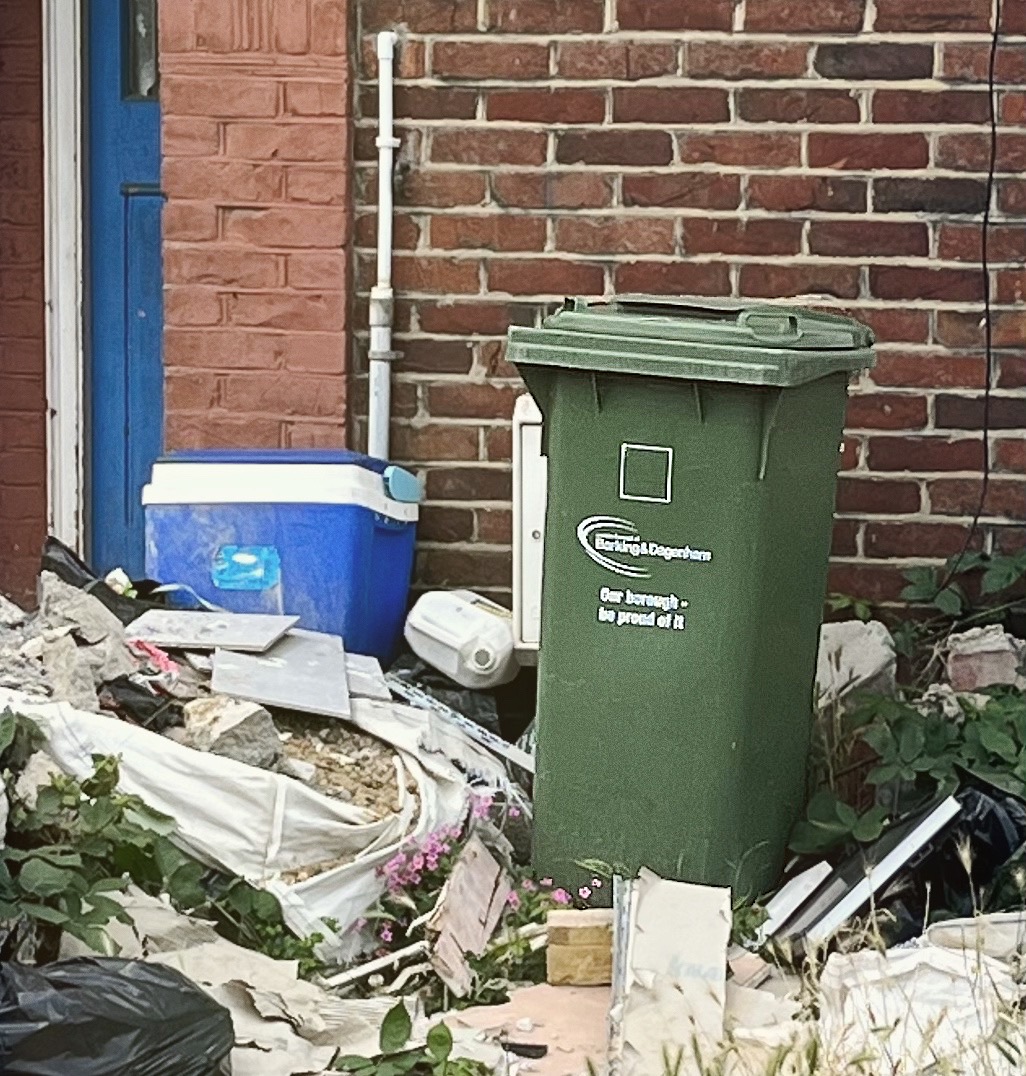
I walked for about half a mile past rows of houses like this one, experiencing a mixture of homes whose residents seemed quite indifferent to the aesthetics of their living space, as well as those where it was clear the abundant flowers and shrubs in their front garden were intended to ward off the powerful drabness that hung over everything like a cloud threatening to rain (interestingly, the photos I took provide evidence that the day was partly cloudy with blue skies, while my memory insists that the weather was persistently grey).
The road eventually took me to the A13 motorway (or, more precisely, ‘trunk road’, a term which I had never heard before the writing of this piece) and I located a pedestrian underpass which could convene me to the other side. The entrance to the subway was weedy and unpleasant. A man was exiting as I made my way in; he spat on the ground as I passed. The walls were heavily graffitied and the interior of the subway was damp and eerily lit. It was the sort of place that unconsciously makes you clench your stomach – not in fear, but in anticipation of perhaps needing to be afraid.
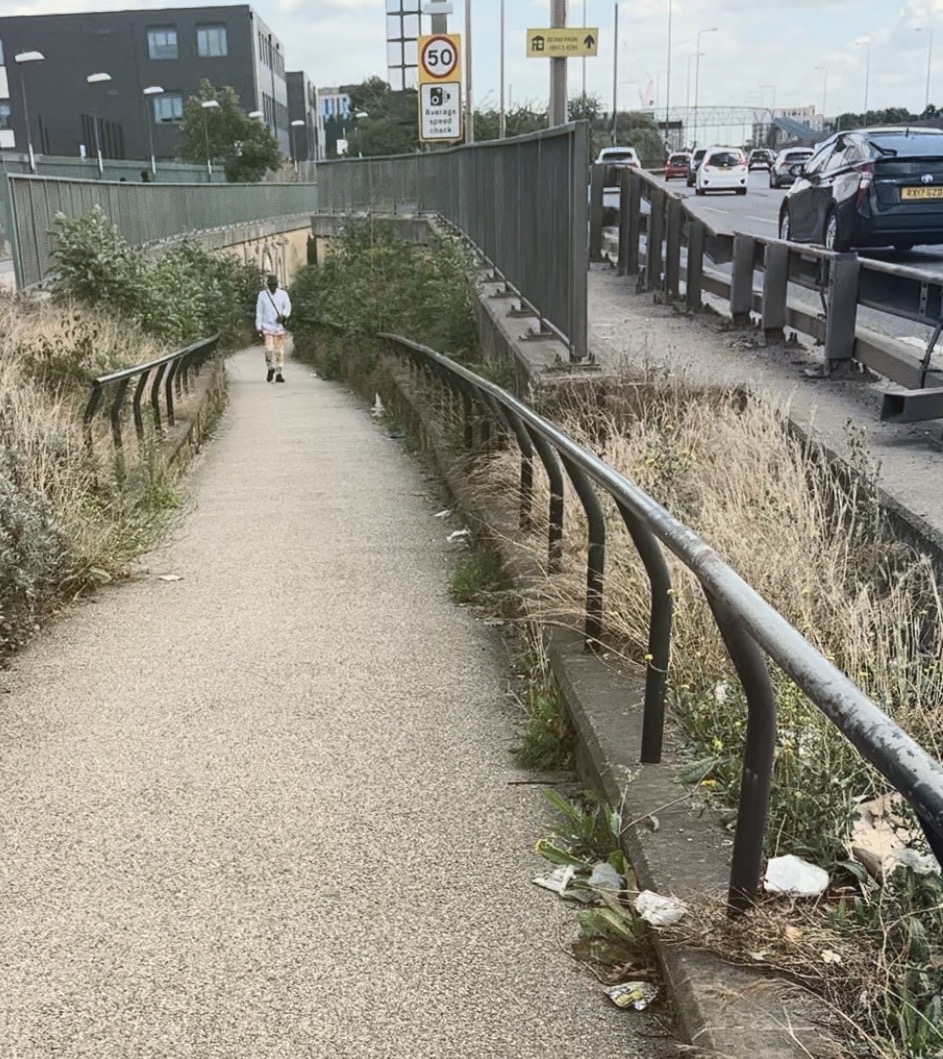
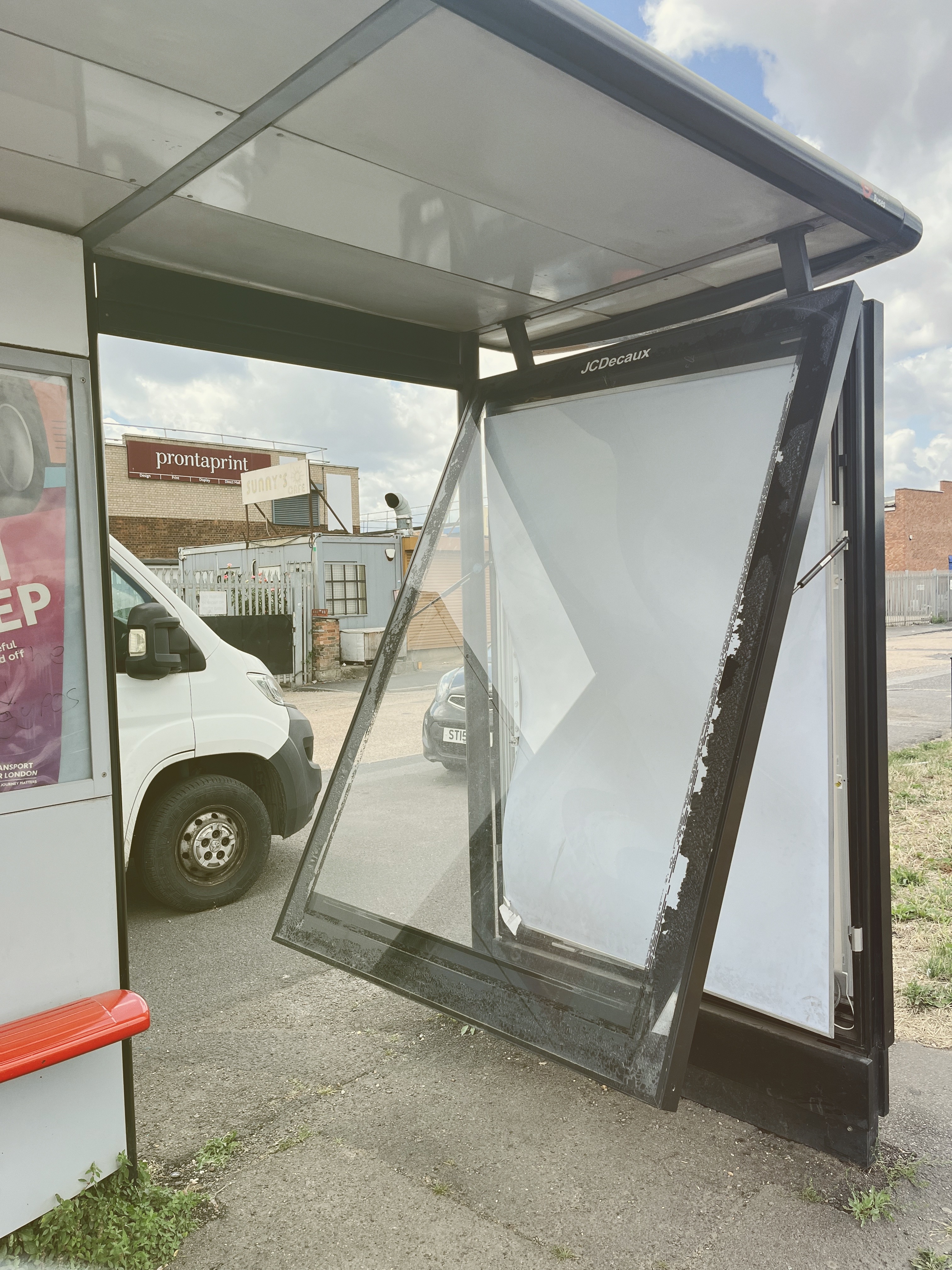
Once on the other side of the A13, there was no obvious route to continue on toward the Thames, so I walked down the trunk road for another half mile past innumerable warehouses, a petrol station, and a bus stop with one side of it blown out, until I reached a left turn which would take me, according to the map on my phone (which I permitted myself to use only minimally), to a place called Barking Riverside.
This is where I started to experience the first waves of doubt. As I tackled the mile-long stroll down Renwick Road from the A13 to Barking Riverside, I kept expecting things to start making sense, for shops to start appearing – real ones, for pedestrians, rather than these stern, brown warehouses strictly for the loading and unloading of lorries – for people, even, to start coming out in greater numbers; the sort of things you’d expect to happen as you approach any urban hub, no matter how drab. But none of this happened. The warehouses eventually gave way to houses and flats, but there was no human activity to speak of, other than one teenager on a bicycle and three young women walking together (swiftly away from Barking Riverside, I noted ominously).

If psychogeography is about noticing the relationship between an ambulatory body and the environment through which it moves, then I was definitely picking up on the fact that this place was not for me. There were pavements, sure (many of them overgrown, leading me to suspect low foot traffic) – in other words, token attempts to appease the rare walker, but with nothing at all that could break up the journey and even, London forbid, make it pleasant. A bench. A flower bed. A small shop to grab a soda water and a bag of peanuts. A monument, even a small one, even just to announce that “this plaque is dedicated to the memory of Hal Whoever.” Nothing. This wasn’t an environment for anyone using their legs as a vehicle; it was for cars, buses, and lorries whose drivers were moving too fast, and were too focused on whatever podcast or song they were playing, to need there to be anything other than the lines on the road to direct them where to go.
My first happy encounter as a walker through this inhospitable landscape involved the discovery of wild blackberries growing at the side of the road. It was July, still early for blackberries, but there were a few which had darkened already. Most of these ripe berries were kept away from me by a metal fence (in fact, every single green space I had seen since the A13 was heavily protected from me by fences, walls, and other barriers). But there was one blackberry within easy reach, and I popped it in my mouth. It was so tart it seared my tongue.
As I approached what my phone assured me was Barking Riverside Station but which at a distance looked suspiciously like another warehouse, I could hear the buzzing of the pylons in an electrical sub-station across the way. It was not the most inspiring approach to the station, but admittedly most people would not be walking here from the A13 but would be arriving on the Overground line which terminates here at what is currently not a place, but a rough sketch of one. Instead of small snack shops and other pedestrians, what began to appear in droves were signs heralding the great life you could have here in Barking Riverside – but there isn’t anything here yet except walls around the empty land where buildings of flats are meant to be constructed. The official Barking Riverside website (which I found later) boasts, rather vaguely, of “new community facilities, cultural events, and business opportunities”. The only ‘business’ I could locate near Barking Riverside Station was a shuttered-up mobile café with photos of flat whites and croissants on its exterior, and the only people I could see (apart from one station attendant whose sole function that day was to inform the few chance passers-by that the Overground line wasn’t running due to engineering works) were a pair of Jehovah’s Witnesses in their Sunday clothes standing at the station entrance with their usual display of salvation-based literature. Why had they chosen to proselytise outside a closed station, in a place that wasn’t even yet a place? Perhaps they were counting on people like me to turn up, out of curiosity or having made a mistake, realise there was nothing to do but sit on an empty concrete bench and stare at the fragile, newly-planted trees shivering in the wind, and so they would strike up a conversation with these spiritual saviours out of desperation to have some kind of experience – because why would anyone travel to a place and be content for nothing to happen?

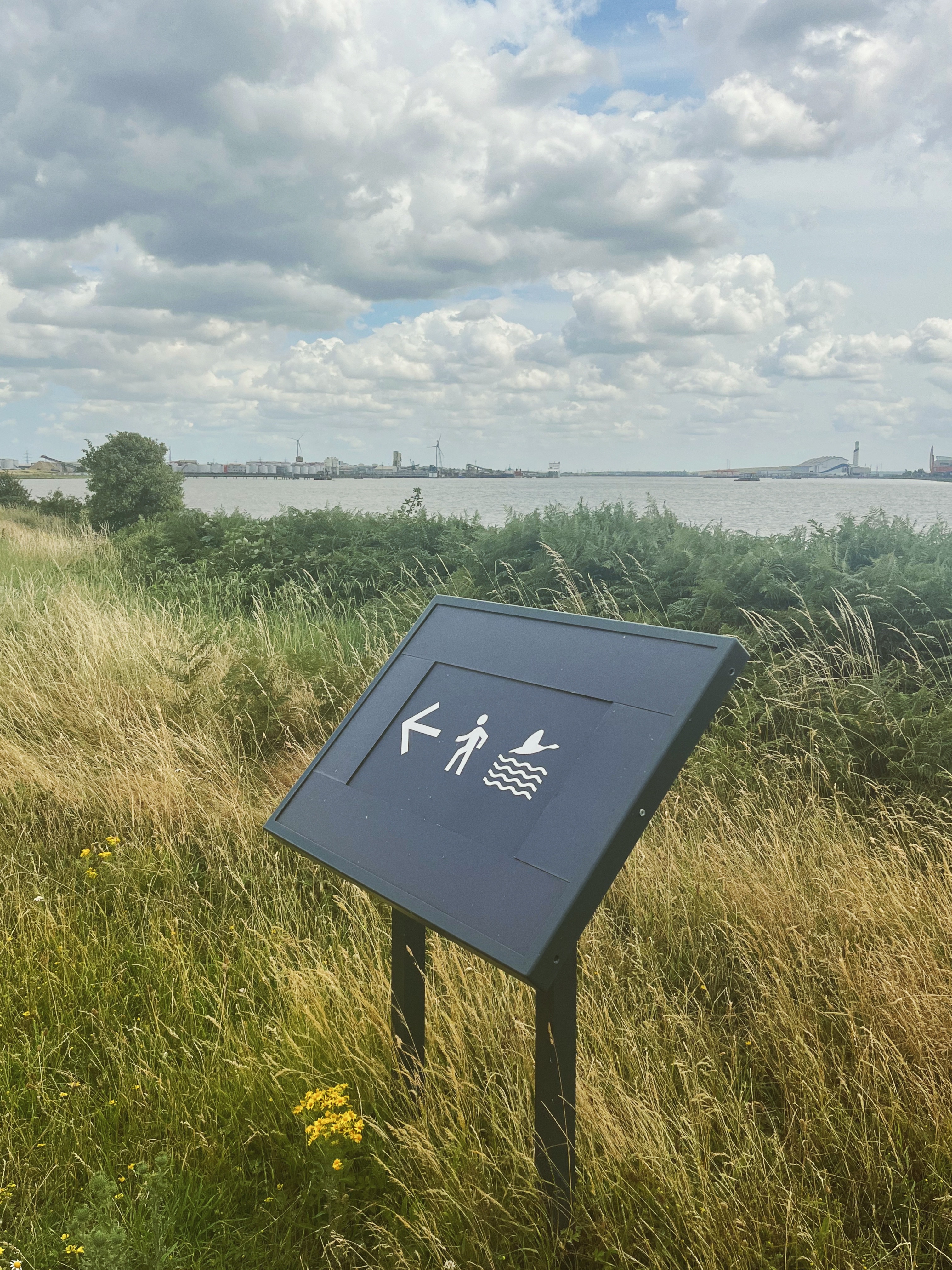
I knew the Thames was nearby, though it was hidden from view by the various construction site barriers that were the main architectural feature of the area. Amidst all the signs for the project office and the branded Barking Riverside logo, I found an arrow pointing me in the direction of a riverside walk. I followed this arrow down a driveway to what I can only describe as a building site-cum-outdoor bar. Nothing here was permanent – it was all trailers, mobile food and drink stands, port-a-loos (with a stern yellow-vested man standing guard, whom I found to be too intimidating to risk asking whether the facilities were public or for builders’ use only), and haphazard tents failing to protect folding tables and chairs from the wind. The culinary choices available were pizza, kebabs (though this stand looked closed, or perhaps closing), ice cream, and cocktails. There were two families – one eating ice creams at a table, and the other playing in an ad-hoc sandbox – consisting of a mother and child each, four bar workers, the yellow-vested man, and me.

I wandered past this strange outdoor bar towards the river itself. I was prevented from reaching the actual water’s edge by wildly unkempt weeds, and despite the cheerful sign pointing me down the river, it seemed that the only thing awaiting me further down the path was a view of the project’s first completed buildings of flats (which looked empty), and some indefinite industrial features (more pylons, warehouses, and a wind turbine) nearer the horizon. I was not feeling inspired to continue my riverside journey, so I did the only other thing I could do besides turn around and go home: I ordered a drink.
It was barely 12pm and, luckily, the cocktail van also offered a selection of mocktails. I ordered a no-jito. While my drink was being prepared, I attempted conversation with the two bartenders about how interesting this place was (I’m sure they knew I meant “odd”), and how interesting (odd) it was that I had come upon it, and… Here I fumbled, because what more can be said about a place that doesn’t really exist, and the people who have somehow found themselves there together?
“There’s not a lot around here, is there?” I said helplessly.
“No,” mumbled the workers.
And with that, the conversation was over. I felt I had done something awkward in voicing the truth of the matter, which is that they were both stuck here all day in this construction site masquerading as a destination, making drinks for no one in particular. They finished and served my no-jito in silence.
The mocktail didn’t take long for me to drink, and then there was nothing else for me to do except, perhaps, play chess with myself using the giant plastic pieces on the grass. But I found the idea even more depressing than sitting and doing nothing. So I left. I caught a bus to Barking station, where I started the long journey back home.
The temptation to feel regret about my trip to Barking Riverside is strong. There were so many other choices I could have made which might have opened up a new and magical side of the area: if only I had walked down the Thames a little bit longer, or asked more interesting questions of the bartenders, or even turned left outside Becontree Station instead of right. What wonders might I have discovered? But all I can work with is the experience I had, and how it felt to be having it.
There was one moment of real magic, however, in this strange and meandering day. I was walking home from South Ealing station, feeling utterly discouraged and worrying that I’d never achieve a decent psychogeographic rapport with London, when I noticed a bag of discarded items next to one of my neighbour’s bins. Upon closer inspection, these items included two plaster figurines of dancers twirling in tiaras and gowns, and an acorn-shaped bowl with the acorn top serving as a removable lid. There was nothing wrong with them; they were simply unwanted. I carried them home and now, the next day, they look as though they’ve been a part of my house for years.

I find it quite telling that the only real moment of pleasing synchronicity took place just three blocks from my home. I may have a strained relationship with London, but I love South Ealing and it has always been good to me. It has given me many found pictures to hang on my walls, and chairs to put in the garden, and surprise gifts from neighbours (as a matter of fact, just this morning our neighbour rang the doorbell to drop off a jar of homemade chutney and a bag of treats for our dog). South Ealing has shown me countless rainbows, and striking patterns of clouds etched into the sky, and apple-green parakeets, and wild blackberries in the park (which are actually sweet). I am always finding something of interest here: an amusing sign, a hidden bit of street art, a community book exchange (in my gym, no less!), and an abundance of airborne fragrances in the form of lavender, jasmine, and honeysuckle spilling out from neighbours’ front gardens. I have been living psychogeographically in this neighbourhood for five years without knowing it.
I don’t know if I will do another psychogeography day like this one that took me to Barking Riverside; possibly I will allow myself to have more control over my starting point next time. But one thing that’s clear to me is that psychogeography (in the sense of pursuing a mindful awareness of and connection to the cityscape) is a worthwhile practice to keep up, especially in one’s neighbourhood. In fact, I feel it’s much more important to cultivate a working relationship with one’s immediate surroundings, because I think this allows us to feel somewhat connected and involved, two feelings which can be in short supply in alienating urban landscapes. London is big enough that I don’t feel particularly bereft if I fail to connect with a certain piece of it – I just want to feel like I know, and am at least slightly known by, my local vicinity.
And perhaps one day Barking Riverside will be a haven of shops, cultural points of interest, and community activity, as its advertising promises. Perhaps, a few years from now, a person strolling home from the Overground station will come across an unwanted chair by the side of the road which would be perfect on their third-floor balcony, or they’ll recognise a neighbour on the street and chat idly about the storm last night, or they’ll pop into the local pub and find to their gleeful surprise that there’s a jazz night on. Perhaps they’ll follow the riverside walk that I did not, and they’ll see a heron in the weeds or a star (or, more likely, a plane) in the sky, and it’ll make them think of something connected to their own life, and a small decision could be made as a result of this brief, almost unconscious, interaction with the land – which, as I understand it, is psychogeography in its purest form, anyway.
 Maria Hummer